“Learning to See” in Movement
“I see you, Neytiri Mo’at’ite.”
In Avatar, Jake Sully, a wounded veteran, enters the world of Pandora through an avatar body.
Neytiri, a skilled Na’vi hunter, is assigned to teach Sully the ways of her people—how to see, live, and belong within the forest in ways the humans are untaught, unable, and, in some cases, unwilling to.

As a personal trainer who is highlighting this clip from the first Avatar film, it might seem, at first glance, that I am casting myself as Neytiri in this metaphor.
But in my experience, one’s own body is “Neytiri,” and one’s mind is “Sully.”
One’s own moving body is part of the natural fabric of life and movement—the natural world within oneself and around oneself. It can sense and see things that, largely, we have not been brought up in our culture to notice and, in some respects, value. Our bodies communicate these things with us constantly—through pain and sensation, tension and ease, postural patterns, gait patterns, and expressive movements—if only we can learn to understand them.
Learning to care for one’s body through methods like Functional Patterns, Anatomy Trains, and certain forms of Pilates is a process of practicing a shift from extraction and control—mining the body for performance and aesthetic appeal—toward participation and belonging within one’s own body and the natural environment of which it is a part.
It is an ongoing, dedicated practice of “learning to see”:
To see one’s body, others’ bodies, and the bodies of non-human systems (both living and inanimate) through a lens of wonder, care, pattern recognition, interest, and longevity, rather than through the narrow goal of extracting output.
Movement training, at its core, is perceptual training. You learn to notice all around you and within you what before could not be perceived. This requires a ritual relational and exploratory practice with the body—one in which one’s intellect becomes the student, and the body, with all its senses (especially sight and sensation), becomes the teacher.
Like Sully learning from Neytiri, a skilled hunter can perceive subtle signs in the environment while tracking an animal that an unskilled hunter simply cannot see. Like hunting, seeing and understanding posture and movement well is a skill of perception, developed through repeated exposure, learning, pattern recognition, and embodied understanding.
As a personal trainer, it is my responsibility to help you learn to see movement patterns and their origins, feel postural and movement changes, and, over time, practice translating what you see into what you feel and what you feel back into what you see.
Christa Lehnert-Schroth, the daughter of Katerina Schroth—who founded the first integrated whole-body in-patient physiotherapy program for scoliosis—emphasized this in her book Three-Dimensional Treatment for Scoliosis (2007).
She wrote that Katerina Schroth believed teaching someone to work with his or her scoliosis was not simply about performing so-called “corrective” exercises (a term I tend to avoid, although it appears in the original German). It was about teaching patients “how to see” and feel their own patterns—and eventually, to recognize those patterns in others.
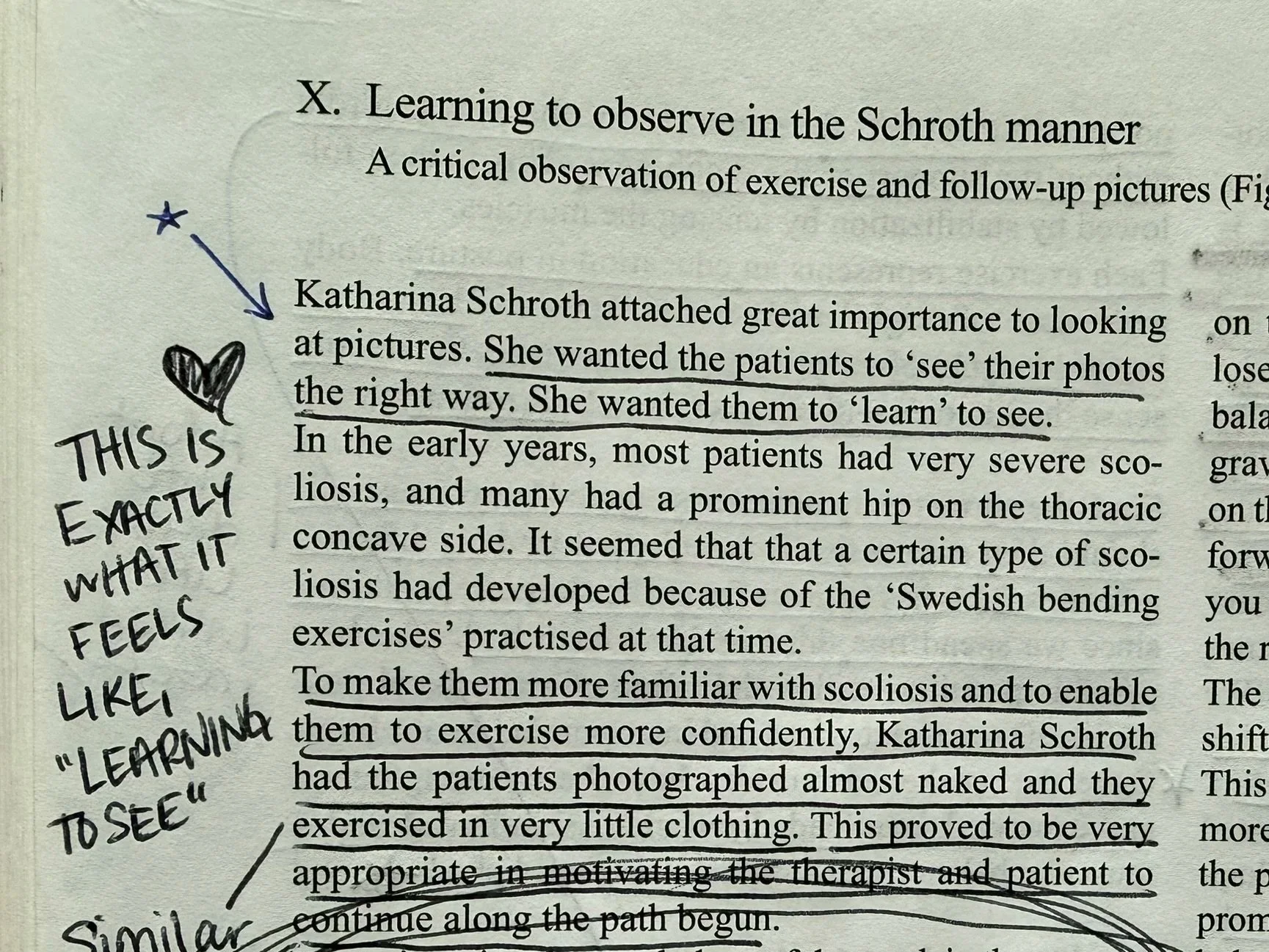
An excerpt from Three-Dimensional Treatment for Scoliosis: A Physiotherapeutic Method for Deformities of the Spine by Christa Lehnert-Schroth, P.T. (2007, p. 78).
This process of discovery—learning to see—is foundational to personal training and healing.
Without it, daily practice can feel like discouraging guesswork: attempts at imitating exercises taught in one-on-one sessions or group classes just hoping for #gainz. However, with this intention of relationality and discovery, daily practice centers the time devoted in relationship with one’s body, trying to learn to listen to it and see it clearly, accepting it for where it is, and nudging it toward greater health and more optimal, innate mechanical loading.
Progress, then, becomes measured by the amount of time inputted into the relationship with one’s body, rather than outcomes and metrics measured against things “out there” — often, images of others’ bodies on social media or within one’s community.
Outcomes are incredibly important; in fact, I would advocate that they are the number one way to assess whether a method and practitioner are a good fit. However, once one enters the process, outcomes are best assessed only very periodically. In the meantime, progress is best measured by time inputted into being with one’s body—on the mat, in the gym, or on the apparatus.
In this way, too, motivation becomes much more easeful, and much less often de-railed by doubts about potential futility. As Sully, in the clip, puts it, “the language is a pain, but, you know, I just figure it’s like field stripping a weapon. Just - repetition, repetition.”
While his Na’vi avatar sleeps after lessons Neytiri, Sully spends his time as a human learning the Na’vi language from his acquaintance, Dr. Norm Spellman.
You hear Spellman explaining the Na’vi phrase “I see you” to Jake Sully:
This is a very important part of it… “I see you.” But it’s not just, “I’m seeing you in front of me.” It’s, “I see into you. I accept you. I understand you.” You gotta get this, okay.
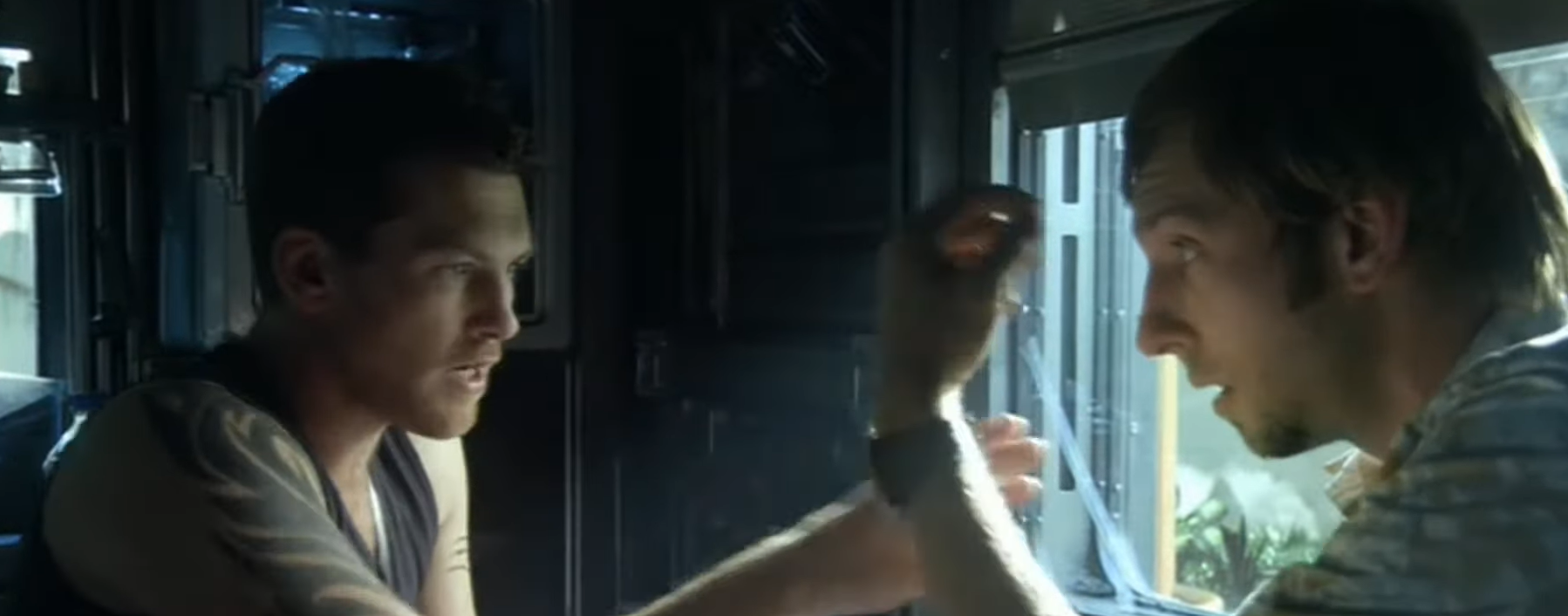
Spellman teaches Sully | From Avatar, Disney (2009).
That kind of seeing—perceptual and relational—is the same capacity movement training aims to cultivate. When we learn to see the body in this way, we stop trying to dominate it, fix it, or override it. Instead, we begin to listen, participate, and belong to the body we have, rather than trying to push it to be a body we do not have.
Daily movement practice then becomes a living dialogue—a practice of saying:
“I see you, Neytiri Mo’at’ite. What do you have today to teach me?”